
Efficient Shippers Use Smart Cartonization Software to Save Big

Last updated on April 3, 2026

 4 minutes
Shipping costs are one of the largest cost centers for any e-commerce business and are second only to labor costs. With last-mile expenses increasing yearly, finding ways to reduce these costs is more important than ever. Leveraging technology to optimize shipping costs by right-sizing packaging can reduce shipping expenses significantly while improving operational efficiency and positively impacting the environment.
What is Cartonization Software and Parcel Packing Intelligence
Starting January 1, 2026, Amazon will no longer offer prep and item labeling services for Fulfillment by Amazon (FBA) shipments in the US store, so sellers must ensure products are prepped and labeled before shipment.
One of the most effective ways to reduce shipping costs is to right-size the packaging. The reason is that shipping rates are based on weight. Still, shippers are charged the higher of the actual shipment weight (product in a box) OR the dimensional weight (the package volume in cubic inches turned into a weight value for rating purposes).
Efficient Shippers have reported saving over six figures just by right-sizing their packaging. Additional savings come from lower packaging costs from using less packaging. Further savings are achieved by reducing or eliminating dunnage required to fill the void in the larger box so items ship safely, less tape is used, etc.
The average return rate for ecommerce orders is in the 15 to 30% range (much higher for apparel); right-sizing the packaging would also reduce the cost of return shipping when the original packaging can be re-used for reverse logistics.
Cartonization software (or smart cartonization features built into Order Management Systems or Multi-Carrier Shipping and Fulfillment Software such as Cahoot) can help automate selecting the best packaging for each order, even for complex shipments containing multiple product and quantity configurations. For example, Cahoot software evaluates the dimensions of the items being shipped and auto-selects the smallest box the products can safely ship in from a list of available options in stock. By using cartonization capabilities prebuilt into software like Cahoot, ecommerce merchants can ensure they are shipping orders in the most cost-effective packaging rather than relying on warehouse staff members to guess the correct size. No human means no judgment is needed, and human errors are eliminated.
A crucial part of parcel packing intelligence, i.e., right-sizing shipments is to stock a wide variety of box, non-corrugate packaging and mailer sizes. Many shippers only stock a limited range of packaging sizes, which forces them to use larger boxes when smaller ones would suffice. Expanding the available box sizes can reduce the risk of paying to ship a lot of air. Some shipping and fulfillment solutions even support the tracking and management of packaging inventory, including cost, reorder points, etc.
It’s worth noting that cartonization and packing tools are useless without accurate dimensional data. Easy AI-based tools such as the Qboid M2 Perceptor Mobile Dimensioning handheld device have recently become available, making capturing these details a breeze.
Increase Sales and Profits through Cartonization Software
For Sellers that can pass shipping costs to their customers, right-sizing packaging increases profits and conversions through more competitive ‘all-in’ product pricing, leading to higher revenues.
Reduce Waste using Smart Cartonization
As of June 20, 2025, Amazon increased the maximum FBA box length in the US from 25 inches to 36 inches, while keeping the maximum width at 25 inches, height at 25 inches, and weight at 50 lb.
While used cardboard boxes can be recycled, much of it still ends up in a landfill with a negative environmental impact and a higher carbon footprint. So, right-sizing shipping supplies also helps the planet.
The best way to minimize cost and environmental impact is not to use overpacks at all – ship the items in their original manufacturer packaging. Amazon’s SIPP program (Ships in Product Packaging) was opened to Amazon FBA Sellers in early 2024 to reduce costs and improve sustainability. It’s generally been regarded as successful.
It’s recommended to collaborate with suppliers to design product packaging to optimize for shipping costs, staying away from the surcharges carriers impose on “oversize” shipments.
Dimensional Weight
As mentioned above, DIM weight considers the package’s volume, meaning large boxes, even when filled with light products, can incur substantial shipping charges.
The DIM weight is calculated by multiplying the package’s length, width, and height, then dividing by a DIM factor set by the carrier. FedEx uses a 139 DIM divisor for U.S. shipments, UPS uses 166 for domestic shipments and 139 for U.S. export/import shipments, and USPS Ground Advantage uses 166 for domestic DIM weight pricing. The higher the DIM factor, the more “air” you can include in a package before triggering the DIM weight pricing.
For example, if you use a 12″x12″x12″ carton, it will be billed as a 13-pound package by FedEx and an 11-pound package by UPS domestic DIM rules, even if the actual contents weigh much less. Over time, these minor discrepancies can add up to thousands of dollars in extra shipping fees. Switching to smaller cartons that more appropriately fit your products can help reduce these DIM weight charges. It also minimizes the need for excess void fill, such as bubble wrap or packing peanuts, which adds cost and waste to each shipment.
An example:
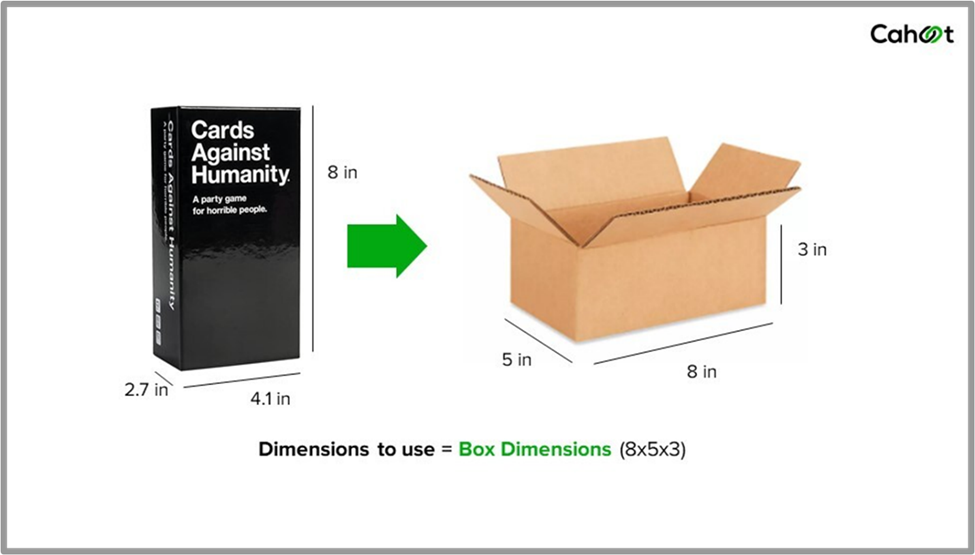
Shipping this 2.25 lb product 8 zones in the 8 x 5 x 5 carton or the 8 x 5 x 3 carton should be re-quoted against the current USPS Ground Advantage retail table; for Zone 8, a 3 lb parcel is $20.75, and DIM pricing does not apply below 1 cubic foot. This is only 2 inches longer on one side but represents 40% air (200 cubic inches vs. 120 cubic inches). That’s over 12% savings on just one shipment and not that egregious of an example. And not including all the waste saved as described above.
Summary
Reducing operations expenses must be a forethought to achieve continued business success. By utilizing technology like cartonization software to optimize shipment packaging, shipping costs can decrease, packaging spend can go down, operational efficiency can improve, and sustainability can improve.
Written By:

Rinaldi Juwono
Rinaldi Juwono leads content and SEO strategy at Cahoot, crafting data-driven insights that help ecommerce brands navigate logistics challenges. He works closely with the product, sales, and operations teams to translate Cahoot’s innovations into actionable strategies merchants can use to grow smarter and leaner.